Few debates in investing generate more passion, more disagreement, and more confusion than the question of growth versus value. On one side sit the disciples of Warren Buffett — patient, analytical investors hunting for underpriced businesses with durable competitive advantages. On the other, the growth investors who have ridden companies like Nvidia, Apple, and Amazon to returns that have made traditional value metrics look hopelessly outdated.
Both camps have periods of spectacular vindication and periods of humbling underperformance. Both have produced legendary investors. Both are built on coherent, defensible investment philosophies supported by substantial evidence. And crucially, both are significantly more complex than the headlines and financial media suggest.
This guide cuts through the oversimplifications. We explain what growth and value stocks actually are, how each investing philosophy works in practice, what the historical data says about their relative performance, which economic environments favour each approach, and — most practically — how most investors should think about incorporating both into a long-term portfolio strategy.
What Are Growth Stocks? The Philosophy and the Characteristics
Growth stocks are shares of companies that are growing — or are expected to grow — at a significantly faster rate than the broader market. The defining characteristic is not the current state of the business but the anticipated trajectory: rapid revenue expansion, expanding market share, transformative technology, and the potential for earnings to compound dramatically over time.
Investors in growth stocks are fundamentally buying a vision of the future. They are paying a premium today for what they believe a company will be worth tomorrow, next year, and in a decade. This forward-looking orientation means growth stocks are typically characterised by:
High valuation multiples: Growth stocks commonly trade at high Price-to-Earnings (P/E) ratios — often 30x, 50x, or even 100x earnings — because investors are pricing in not just current earnings but years of rapid future earnings growth. In some cases, particularly for early-stage growth companies, P/E ratios are irrelevant because the company is currently unprofitable, reinvesting all revenue into growth.
Low or no dividends: Growth companies typically reinvest virtually all profits back into the business — into research and development, talent acquisition, geographic expansion, and product development. The return to shareholders comes from capital appreciation, not income distribution.
Rapid revenue and earnings growth: The most fundamental characteristic. A growth company is one whose revenue is expanding at 20%, 30%, 50%, or more annually — far outpacing the broader economy.
Dominant or disrupting market position: Many growth stocks are either rapidly taking market share from established competitors or creating entirely new markets. Technology, healthcare innovation, clean energy, and software-as-a-service have been the most fertile ground for growth investing in recent decades.
High price volatility: Because growth stocks are valued on future expectations, they are highly sensitive to changes in those expectations. A quarterly earnings miss, a change in guidance, or a shift in the competitive landscape can cause a growth stock to fall 20% or 30% in a single day. Growth investing requires substantial tolerance for this volatility.
Classic examples of growth stocks have included Amazon during its long period of reinvesting profits into infrastructure and new businesses, Nvidia as artificial intelligence transformed its GPU chips into the infrastructure of the AI economy, and Tesla as it redefined the electric vehicle market. Each of these companies spent years trading at valuations that traditional metrics labelled as expensive — and each went on to deliver extraordinary returns to patient investors.
What Are Value Stocks? The Philosophy and the Characteristics
Value investing has a longer and more formal intellectual heritage than growth investing. Its modern foundations were laid by Benjamin Graham — the economist, investor, and Columbia University professor who taught Warren Buffett — whose 1949 book The Intelligent Investor remains one of the most influential investment texts ever written.
The core premise of value investing is disarmingly simple: stocks sometimes trade at prices below what the underlying business is actually worth. When this happens — due to temporary bad news, sector pessimism, general market panic, or simple neglect — a patient investor can buy those stocks at a discount and earn superior returns as the market eventually corrects its mispricing.
Value investors are not buying bad businesses. They are buying good or decent businesses at bad (i.e., low) prices — then waiting for the price to reflect the true worth.
Value stocks are typically characterised by:
Low valuation multiples: Value stocks trade at low Price-to-Earnings (P/E) ratios — often 8x to 15x earnings — and low Price-to-Book (P/B) ratios, typically below 1.5x.www.investopedia.com These metrics suggest the market is assigning a low price to the company’s current earnings and assets.
Meaningful dividend yields: Because value companies are often mature, established businesses with stable cash flows, they frequently pay substantial dividends — returning cash to shareholders rather than reinvesting it all in growth. A dividend yield of 2% to 5% or higher is common among value stocks.
Stable, established business models: Value stocks are often found in mature industries — banking, insurance, energy, consumer staples, utilities, manufacturing — where business models are well understood, competitive dynamics are established, and revenue is relatively predictable.
Lower price volatility: Value stocks, being priced conservatively and often paying dividends, tend to be less volatile than growth stocks. They fall less dramatically during market downturns and rise less dramatically during bull markets.
Potential catalysts for re-rating: The investment thesis for a value stock typically involves a specific reason why the market has mispriced the company — a temporary earnings problem, a spin-off or restructuring, management change, or general sector pessimism — and a specific catalyst that might cause the market to recognise the true value.
Classic examples of value investing in action include Warren Buffett’s purchase of American Express after the Salad Oil Scandal of the 1960s, Berkshire Hathaway’s investments in Coca-Cola, Wells Fargo (in earlier decades), and IBM. More recently, Buffett’s massive investment in Apple — which many consider a hybrid of value and quality investing — represents a sophisticated modern application of the philosophy.
The Key Metrics: How to Identify Growth vs Value Stocks
Understanding the financial metrics used to distinguish growth from value stocks is essential to applying either philosophy in practice.
Metrics Associated with Value Stocks
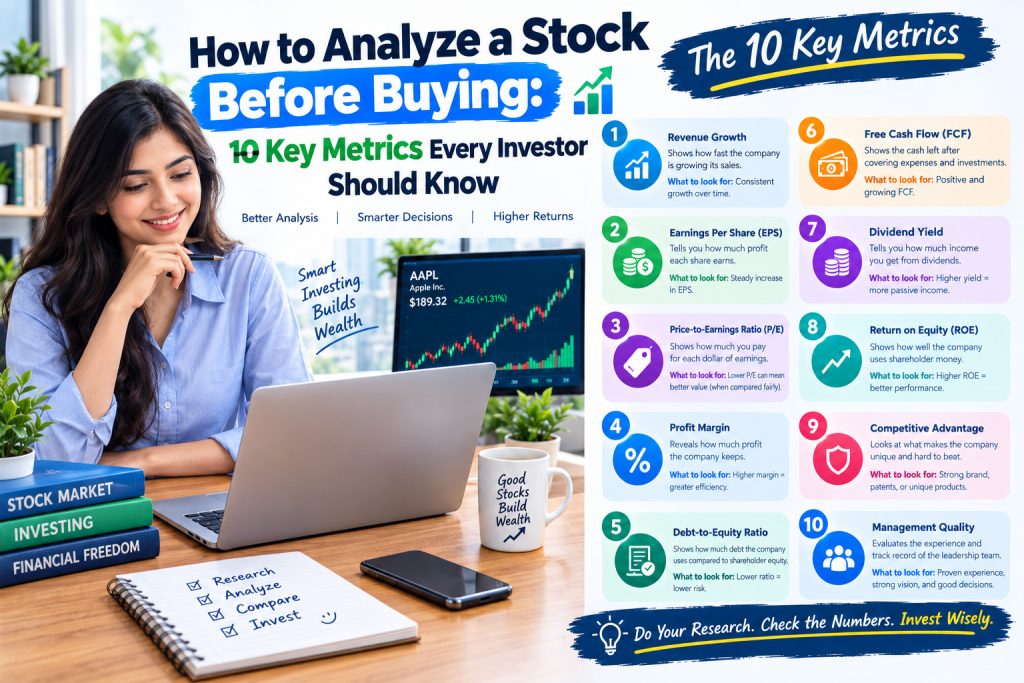
Price-to-Earnings (P/E) Ratio: The most widely used valuation metric — a stock’s share price divided by its earnings per share. A low P/E suggests the market is paying little for each dollar of current earnings, which may indicate undervaluation. Value investors typically seek P/E ratios below the market average (roughly 20–25x for the S&P 500 historically).
Price-to-Book (P/B) Ratio: Compares a company’s market capitalisation to its book value (total assets minus total liabilities). A P/B ratio below 1.0 suggests a stock is trading below the value of its net assets.www.nbc.ca A low P/B is a classic value signal, though it is most useful in asset-heavy industries like banking, insurance, and manufacturing.
Dividend Yield: Calculated as the annual dividend per share divided by the share price. Value stocks often carry higher dividend yields — a 3% to 6% yield suggests the market is pricing the stock conservatively relative to its income-generating capacity.
Price-to-Sales (P/S) Ratio: Compares market cap to annual revenue. A low P/S can signal undervaluation, particularly for companies with temporarily depressed margins.
Enterprise Value to EBITDA (EV/EBITDA): A more comprehensive valuation metric that adjusts for debt levels. Value investors often use EV/EBITDA to compare companies across different capital structures.
Metrics Associated with Growth Stocks
Revenue Growth Rate: The single most important growth metric — the annual percentage increase in revenue. Sustained 20%+ annual revenue growth is the hallmark of a genuine growth stock.
Earnings Growth Rate: How quickly earnings per share are growing. For early-stage growth companies, future earnings growth projections are more relevant than current earnings.
Price-to-Earnings-to-Growth (PEG) Ratio: Adjusts the P/E ratio for growth expectations — a PEG below 1.0 suggests a stock may be attractively valued given its growth rate, while above 2.0 suggests the market is pricing in optimistic growth assumptions.
Total Addressable Market (TAM): Growth investors assess how large the market opportunity is for a company’s products or services. A company capturing 2% of a $1 trillion market has very different growth potential than one with 40% share of a $5 billion market.
Return on Invested Capital (ROIC): For quality-oriented growth investors, ROIC measures how efficiently a company generates returns from the capital it deploys. High and rising ROIC is a hallmark of a compounding growth machine.
The Historical Performance Debate: What the Data Actually Shows
The debate between growth and value investing is not purely philosophical — there is a substantial body of academic research examining which approach has produced better long-term returns.
The Value Premium: The Academic Evidence
The most influential research on value investing comes from Eugene Fama and Kenneth French — Nobel laureate and leading financial economist respectively — who documented what became known as the “value premium.” Their landmark 1992 and subsequent papers found that, over long historical periods, value stocks (defined by high book-to-market ratios) significantly outperformed growth stocks across US and international markets.mba.tuck.dartmouth.edu
JP Morgan Asset Management confirms that Fama and French’s research shows many prolonged periods of value outperformance over the past century and that value has outperformed growth cumulatively over very long time horizons.am.jpmorgan.com
The academic explanation for the value premium has two main competing theories. The risk-based explanation argues that value stocks outperform because they are genuinely riskier — they are often distressed companies facing genuine business challenges, and investors demand higher returns for holding them. The behavioural explanation argues that the premium exists because investors systematically overpay for exciting growth stories and systematically undervalue boring, out-of-favour businesses — creating persistent mispricings that patient value investors can exploit.
Growth’s Decade: 2012–2021
Whatever the long-term historical record, the most recent extended period of clear performance data favoured growth investing decisively. From approximately 2012 through 2021, US growth stocks — led by the technology giants that would come to dominate the S&P 500 — dramatically outperformed value stocks, with the Russell 1000 Growth index far exceeding the Russell 1000 Value index.
The drivers of this extended growth outperformance included:
- Near-zero interest rates: When interest rates are very low, future earnings are discounted at a lower rate, making growth stocks — whose value lies primarily in future earnings — relatively more attractive versus value stocks generating current income.
- Technology’s structural advantages: Digital platforms exhibit winner-take-most dynamics, network effects, and extraordinary operating leverage that traditional value metrics are poorly designed to capture.
- Globalisation and TAM expansion: The internet created genuinely massive new markets, validating growth investors’ willingness to pay high multiples for companies with access to billions of potential customers.
Value’s Return: 2022 and Beyond
The environment shifted sharply in 2022. As the Federal Reserve aggressively raised interest rates to combat the highest inflation in decades, growth stocks — whose valuations are disproportionately dependent on discounting future earnings at low rates — fell dramatically. The Nasdaq dropped over 33% in 2022, while many individual high-growth technology companies fell 60% to 80% from their peaks.
Value stocks, with their lower duration (financial sensitivity to interest rate changes), stable current earnings, and dividend income, dramatically outperformed during this period. MarketWatch confirmed the research consensus that value stocks tend to beat growth stocks when inflation accelerates and interest rates rise, because growth stocks’ valuations are disproportionately dependent on earnings further into the future.www.marketwatch.com
The pattern held: when the macroeconomic environment changed from low-rate expansion to high-rate tightening, the style that had underperformed for a decade suddenly became the outperformer.
Which Economic Environments Favour Each Style?
Understanding the economic conditions that historically favour growth versus value is one of the most practical frameworks for thinking about asset allocation between the two styles.
Conditions That Favour Growth Stocks
Low interest rates: This is the single most important macroeconomic condition for growth stock performance. When rates are near zero or very low, the future earnings that give growth stocks their value are discounted at lower rates, making them more attractively valued relative to their prices. The 2010–2021 zero-rate environment was the perfect incubator for growth stock outperformance.
Economic expansion: During strong economic growth, corporate revenues across the economy rise, but the fastest-growing companies see the most dramatic benefit. Investors are confident about the future, willing to pay premium multiples for future earnings, and tolerant of current unprofitability.
Low inflation: When inflation is stable and low, growth companies’ future earnings maintain their purchasing power. High inflation erodes the real value of future earnings and makes current income (which value stocks provide through dividends) more attractive by comparison.
Technological disruption: When new technologies are creating genuinely massive new markets — as the internet did in the 2000s, smartphones in the 2010s, and artificial intelligence is doing in the 2020s — growth companies at the forefront of disruption can generate returns that no valuation metric at purchase would have predicted.
Conditions That Favour Value Stocks
Rising interest rates: Higher rates increase the discount rate applied to future earnings, reducing the present value of growth stocks more than value stocks. Value stocks — with their current earnings, dividends, and lower duration — are relatively less sensitive to rate increases.
High inflation: Inflation erodes the real value of future earnings and makes immediate income more attractive. Companies with pricing power, stable dividends, and asset-heavy balance sheets (common value characteristics) tend to weather inflation better than high-multiple growth stocks.
Economic recovery after recession: In the early stages of economic recovery, beaten-down value sectors — financials, industrials, energy, consumer cyclicals — often lead the rebound, as investor confidence returns and they rediscover undervalued, profitable businesses trading at recession-era multiples.
Mean reversion: When growth stocks have significantly outperformed for an extended period, their valuations relative to value stocks tend to be stretched. Historically, these periods of extreme relative valuation have been followed by value outperformance as multiples normalise.
The Case for Growth Investing: Why It Has Captivated Investors
Beyond the macroeconomic arguments, growth investing appeals to a fundamental human instinct: the desire to participate in transformative change. The companies that define an era — Amazon remaking commerce, Google remaking information access, Nvidia enabling AI — generate returns that cannot be achieved by buying inexpensive but uninspiring businesses at low multiples.
Compounding at high ROIC: The most powerful feature of exceptional growth companies is their ability to reinvest profits at high rates of return for extended periods. A company that earns 25% ROIC and reinvests 80% of earnings is compounding its intrinsic value at 20% annually — a pace that makes the initial purchase price look modest over a decade.
The power of optionality: Great growth companies often develop new revenue streams and market opportunities that were not visible at the time of the original investment. Amazon’s cloud computing division (AWS) was barely imaginable when Amazon was primarily viewed as an online bookstore. Microsoft’s transformation into a cloud and AI company happened long after most investors had written it off. These option values are simply not captured in current earnings multiples.
Winner-take-most dynamics: Many modern growth businesses — particularly digital platforms, software, and AI — exhibit network effects and switching costs that create durable competitive moats. Once a platform achieves critical mass, competitors find it nearly impossible to displace it, and the company can sustain high growth rates for longer than traditional economic analysis would predict.
The Case for Value Investing: Why Buffett’s Philosophy Endures
For all of growth investing’s allure, value investing’s intellectual foundations are arguably more robust, its psychological demands more disciplined, and its margin of safety more explicit.
The margin of safety: Benjamin Graham’s central concept — that the difference between a stock’s price and its intrinsic value provides a cushion against errors in analysis — is a risk management principle that growth investing generally lacks. When you buy a stock at 8x earnings, you have substantial margin for error. When you buy at 80x earnings, any disappointment can be catastrophic.
Mean reversion works in your favour: Every business faces periods of difficulty — temporary earnings declines, competitive pressure, management transitions. A value investor who purchases during one of these difficult periods is positioned to benefit as conditions normalise and the stock re-rates toward fair value. This mean reversion is one of the most persistent patterns in financial markets.
Dividend income compounds independently: Value stocks frequently pay meaningful dividends that can be reinvested regardless of whether the market appreciates the underlying business. This provides a return component that is not dependent on multiple expansion or continued growth acceleration.
Behavioural advantage: Value investing explicitly exploits the gap between market price and intrinsic value created by investor psychology — fear, greed, recency bias, and attention bias. By buying what is ignored, unpopular, or temporarily out of favour, value investors systematically take the other side of other investors’ emotional mistakes.
Warren Buffett’s record: The most compelling advertisement for value investing is Warren Buffett’s five-decade track record at Berkshire Hathaway — compounding capital at approximately 20% annually over 50+ years, building one of the world’s largest fortunes through disciplined application of value principles.www.investopedia.com While Buffett’s later philosophy evolved from pure Graham-style cheap stocks toward quality businesses at fair prices, the fundamental discipline of paying less than intrinsic value has remained constant.
The False Dichotomy: Why the Smartest Investors Don’t Choose
The most important insight in the growth versus value debate is this: the framing of the question is flawed. Sophisticated investors do not choose between growth and value — they incorporate the insights of both.
Warren Buffett himself represents the evolution of this synthesis. Trained by Graham as a pure value investor, he was transformed by his partner Charlie Munger into an investor who seeks “wonderful businesses at fair prices rather than fair businesses at wonderful prices.” His investment in Apple — then the world’s most valuable company by market capitalisation — was simultaneously growth investing (buying one of the fastest-growing, highest-ROIC businesses in history) and value investing (buying at what Buffett calculated was a reasonable price given Apple’s earnings power, brand strength, and competitive moat).
The academic research supports the combination. Studies examining “quality growth at a reasonable price” (GARP) strategies — finding companies with above-average growth rates but below-average valuations given that growth — have consistently shown superior risk-adjusted returns compared to either pure growth or pure value approaches.
In practice, a blended approach might look like:
- A core holding in a broad total market index fund (which automatically includes both growth and value stocks across all sectors)
- A deliberate tilt toward value through a value-focused ETF (such as VTV or VONV) to increase exposure to the historically documented value premium
- Selective individual stock investments in high-quality growth companies purchased at reasonable valuations relative to their long-term earnings potential
ETFs for Implementing Growth and Value Exposure
For investors who want deliberate growth or value exposure beyond what a total market index fund provides, low-cost ETFs make implementation straightforward.
Growth ETFs:
- Vanguard Growth ETF (VUG) — tracks the CRSP US Large Cap Growth Index; expense ratio 0.04%
- iShares Russell 1000 Growth ETF (IWF) — tracks the Russell 1000 Growth Index; expense ratio 0.19%
- Schwab U.S. Large-Cap Growth ETF (SCHG) — low-cost growth exposure; expense ratio 0.04%
Value ETFs:
- Vanguard Value ETF (VTV) — tracks the CRSP US Large Cap Value Index; expense ratio 0.04%
- iShares Russell 1000 Value ETF (IWD) — tracks the Russell 1000 Value Index; expense ratio 0.19%
- Schwab U.S. Large-Cap Value ETF (SCHV) — expense ratio 0.04%
Blended / GARP ETFs:
- Vanguard Total Stock Market ETF (VTI) — the broadest blended exposure; expense ratio 0.03%
- iShares MSCI USA Quality Factor ETF (QUAL) — targets companies with high quality characteristics across both style segments; expense ratio 0.15%
Which Is Better? The Honest Answer
The honest answer to the question “which is better — growth or value?” is: it depends, and both have a role to play.
If you are a beginning investor with a long time horizon (20+ years), a broad total market index fund provides automatic blended exposure to both growth and value stocks at market weights. You capture the long-term return of the entire market without having to predict which style will outperform in any given cycle. This is the approach recommended for most investors most of the time.
If you are an intermediate investor willing to manage additional complexity, a core total market position supplemented by a deliberate value tilt (using a value ETF) reflects the academic evidence that the value premium has existed over very long periods, while still maintaining diversified market exposure.
If you are a sophisticated investor with specific skills in business analysis, a GARP approach — seeking high-quality businesses with durable competitive advantages, strong ROIC, and reasonable valuations — represents the synthesis that the most successful investors across multiple generations have converged on.
If you are trying to predict which style will outperform in the next 1–3 years, stop. The cycles of growth and value outperformance are driven by macroeconomic forces — interest rates, inflation, economic cycles — that are notoriously difficult to predict. Investors who have tried to time style rotation have overwhelmingly underperformed those who maintained consistent, diversified exposure through cycles.
The data from J.P. Morgan Asset Management makes the point clearly: while there have been many prolonged periods of value outperformance over the past century, there have also been extended periods of growth outperformance. Maintaining exposure to both styles through a blended index approach is the most reliable strategy for capturing long-term market returns without the risk of being on the wrong side of a style cycle for a decade.
Common Mistakes in Growth and Value Investing
Growth trap: Overpaying for growth that fails to materialise. Many companies that trade at extreme growth multiples disappoint — either their growth slows, competition intensifies, or the market opportunity proves smaller than anticipated. The investor who paid 100x earnings for a company that delivers average results faces devastating losses.
Value trap: Buying a stock that is cheap for good reason. Not all cheap stocks are undervalued — some are cheap because the business is genuinely deteriorating, the competitive position is eroding, or the industry is in structural decline. A low P/E that persists for years while earnings continue to decline is a value trap, not a value opportunity.
Style drift: Investors who label themselves value investors but stretch their criteria to buy expensive stocks during growth bull markets — or growth investors who buy cheap, declining businesses during value rallies — are subject to the worst of both worlds. Discipline within a chosen framework is as important as the framework itself.
Recency bias: The most pervasive mistake in style investing is extrapolating recent outperformance. After growth dramatically outperformed in the 2010s, many investors shifted entirely to growth — just before value’s strong recovery in 2022. After value outperformed in 2022, some investors swung back — just as growth re-accelerated in the AI era.
Final Thoughts: The Question Behind the Question
The debate between growth and value investing ultimately reveals something deeper than a disagreement about metrics or strategies. It reveals two fundamentally different views of how markets work and where investment opportunity lies.
Growth investors believe that exceptional businesses — those that can sustain above-average returns on capital for extended periods — are worth paying premium prices for, and that the market systematically underestimates how long and how powerfully great businesses can compound.
Value investors believe that markets systematically overprice excitement and undervalue the mundane, and that patient, analytical investors who buy carefully and wait patiently for prices to reflect reality will be rewarded over time.
Both beliefs have produced exceptional investors. Both have compelling theoretical foundations. Both have periods of market validation and humbling underperformance.
For most investors, the practical answer is not to choose but to diversify across both approaches — maintaining exposure to the full market while selectively tilting toward whichever style offers better risk-adjusted value given current market conditions and your own investment horizon.